
When Google Answers Without a Click: What AI Overviews Mean for Small Business Traffic
AI Overviews and AI Mode change how people move from search to websites. Here is how small businesses should think about fewer clicks, better intent, and lead tracking.
The scariest version of AI search is simple: Google answers the question, the visitor never clicks, and your website loses traffic.
That can happen. It has already happened for many informational searches. If someone asks, "what is above the fold?" or "what is schema markup?" they may get enough of an answer directly in the results page. A site that relied on basic definition traffic may lose some of those visits.
But service businesses should be careful before treating every lost click as lost revenue. A visitor who wanted one sentence may never have become a lead. A visitor who asks a specific buying question, compares providers, checks reviews, and then clicks may be more valuable than five casual visitors who bounced after ten seconds.
AI Overviews and AI Mode do not make traffic meaningless. They make weak traffic easier to lose and qualified traffic more important to measure.
The Old Funnel Was Already Messy
The classic SEO story was clean: someone searches, sees your result, clicks your site, reads, contacts you.
Real life was never that clean.
A buyer might:
- Search a generic question.
- Read a blog post.
- Leave.
- Ask a friend.
- Check Google Maps.
- Read reviews.
- Visit a competitor.
- Search your brand name.
- Call from your Business Profile.
- Fill out the form three days later.
Attribution was already imperfect. AI search adds another layer. A buyer may ask Google AI Mode or ChatGPT for a comparison, read a summary, click one cited source, search the business name separately, and then convert from a different channel.
If your measurement plan depends only on last-click organic traffic, you will misread what is happening.
What AI Overviews Are Likely to Change
For small business websites, expect four changes.
1. Basic informational clicks may drop
Definitions, simple checklists, generic "what is" questions, and commodity advice are easier for AI systems to answer without a click.
If your blog strategy is built entirely on generic posts like "5 tips for choosing a contractor," the risk is real. That kind of content is easy to summarize and hard to differentiate.
2. Complex research may generate better clicks
Google says AI Overviews and AI Mode are designed to help with complex topics and exploration. Their documentation also says AI features may use query fan-out, pulling from multiple related searches and sources.
That means the click that does happen may come after more pre-qualification. The visitor may already understand the problem, compare approaches, and arrive with a sharper question.
Those clicks may be fewer, but better.
3. Brand searches become more important
If AI search introduces your business name in a summary, the next action may not be a direct click from the AI result. The user may search your brand, open your Business Profile, check reviews, or type the URL directly.
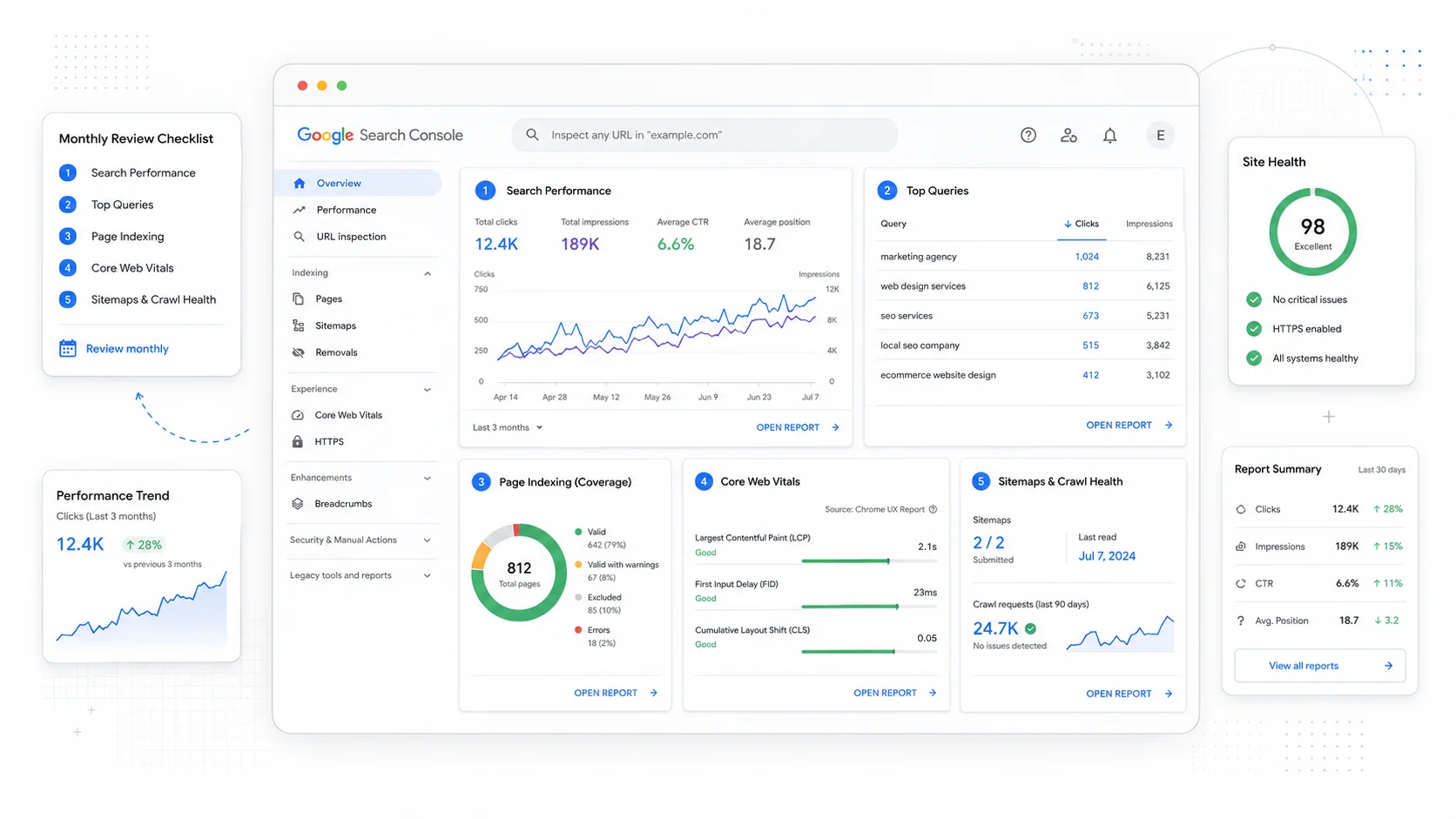
That makes brand demand a more important metric. Watch branded searches, direct traffic, Google Business Profile actions, and assisted conversions.
4. Content quality has less room to hide
AI search is harsh on vague content. It can summarize commodity advice from anywhere. To earn a click, your page needs something worth leaving the results page for: real examples, pricing detail, a calculator, a case study, a local angle, photos, diagrams, templates, or a strong point of view.
If the answer can be fully satisfied in three generic paragraphs, do not expect durable traffic from it.
What to Measure Instead of Panic
Traffic is still useful, but it is not enough.
For a service business, the dashboard should include:
- Organic impressions.
- Organic clicks.
- Branded search volume.
- Non-branded search volume.
- Contact form submissions.
- Calls from the website.
- Calls from Google Business Profile.
- Booking clicks.
- Quote requests.
- Email clicks.
- Qualified lead count.
- Close rate by lead source.
- Revenue by lead source where possible.
The goal is to separate "traffic changed" from "business changed."
Example:
- Organic clicks down 18 percent.
- Leads down 2 percent.
- Close rate up 9 percent.
- Revenue flat.
That is not a crisis. It may mean weaker research traffic evaporated while buying traffic remained.
Different example:
- Organic clicks down 18 percent.
- Leads down 30 percent.
- Calls down 35 percent.
- Branded searches flat.
That is a business problem. You need to investigate rankings, AI result inclusion, local visibility, technical SEO, reviews, and conversion paths.
Our guide to Google Search Console reports is a good starting point, but Search Console alone will not show the full picture. Pair it with analytics, call tracking, CRM data, and Business Profile metrics.
Content That Still Deserves the Click
The click is not dead. Lazy content is in trouble.
These content types still give people a reason to visit:
Original examples
"How much does a website cost?" is easy to summarize. "Here are three real website budgets and what each one included" is harder to replace.
Local specificity
"How to choose a roofing company" is generic. "What Omaha homeowners should check before replacing a roof after hail season" has local usefulness.
Decision tools
Calculators, checklists, templates, comparison tables, and diagnostic guides create utility beyond an answer snippet.
Strong opinions with tradeoffs
AI systems are good at average advice. Humans still want judgment. A post that says "do not rebuild yet; fix these three pages first" is more useful than a neutral summary.
Visual proof
Photos, screenshots, before-and-after examples, process diagrams, and annotated audits make a page worth opening.
Pricing and process clarity
Many service businesses avoid pricing details. That creates an opening. A page that explains ranges, variables, and next steps can earn both trust and citations.
Make the Landing Page Worth the Visit
If AI search sends fewer but better clicks, your landing pages need to carry more weight.
Check the pages that already receive organic traffic. For each one, ask:
- Does the page answer the question quickly?
- Does it make the next step obvious?
- Is the business name and service area clear?
- Is there proof near the top?
- Is the call to action specific?
- Does the mobile version work cleanly?
- Is the page fast after the first load?
- Is the form short enough?
- Can someone call without hunting?
- Does the page connect to related service pages?
AI search may do more pre-selling before the click. Do not waste that intent with a page that feels generic, slow, or unclear.
Use Snippet Controls Carefully
Some site owners want to block snippets or limit how much content Google can show. Google documents controls like nosnippet, data-nosnippet, and max-snippet.
These controls can reduce how much of your content appears in search features, including AI features. They can also reduce visibility and make your pages less compelling in search results.
For a typical service business, snippet blocking is usually a blunt instrument. If your public content exists to attract leads, blocking summaries may harm more than it helps. If you publish protected, paid, or sensitive content, the calculation changes.
Use preview controls intentionally. Do not add them because a thread on social media made AI summaries sound scary.
Build for Assisted Discovery
The future path may look like this:
- Customer asks an AI search tool for options.
- Your business appears as one source among several.
- Customer reads the summary.
- Customer searches your brand.
- Customer checks reviews.
- Customer visits a service page.
- Customer calls from the mobile header.
If you only measure step 6, you miss the real path.
Build for the whole path:
- Make your brand name consistent.
- Keep Business Profile current.
- Request reviews continuously.
- Publish service pages with clear locations.
- Add case studies.
- Use schema where appropriate.
- Keep phone and contact actions visible.
- Track calls and forms.
- Ask new leads how they found you.
That last one is old-fashioned and still useful. A required CRM dropdown will never be perfect, but a quick "where did you first hear about us?" can reveal patterns analytics misses.
The Practical Response
Do not respond to AI Overviews by publishing more generic posts. That is the easiest content for AI to absorb without a click.
Respond by making your website more useful than the summary:
- More specific service pages.
- Better proof.
- Better local detail.
- Clear pricing guidance.
- Stronger internal links.
- Better conversion paths.
- Better measurement.
Clicks may become harder to earn for broad informational content. That does not mean websites stop mattering. It means the website has to become the trusted source and the conversion surface, not just a pile of keyword pages.
For small service businesses, the opportunity is still there. Most competitors will panic, block things they do not understand, publish generic AI-written content, or ignore measurement. A business that becomes the clearest, most useful source in its category can still win.
The click is not guaranteed anymore. Make it worth earning.
More posts from the blog.
From Contact Form to CRM: The Minimum Lead Pipeline Every Service Business Should Automate
A practical lead pipeline for service businesses: connect forms, calls, email, CRM records, reminders, follow-ups, and reporting so good leads stop disappearing.
The 2026 Website Content Refresh Playbook: Updating Old Pages Without Breaking SEO
A practical content refresh process for small business websites: how to update stale pages, preserve rankings, improve AI search visibility, and avoid SEO mistakes.
The AI Chat Widget Decision: When It Helps Leads and When It Hurts Trust
AI chat widgets can qualify leads and answer common questions, but they can also slow the site, invent answers, mishandle privacy, and damage trust. Here is how to decide.
Keep reading?
More field notes from building modern websites and software for real businesses.