
Content Strategy for Small Businesses Without a Marketing Team
A realistic content strategy for small businesses with no marketing team. Pillar pages, topic clusters, publishing cadence, repurposing, and when to outsource.
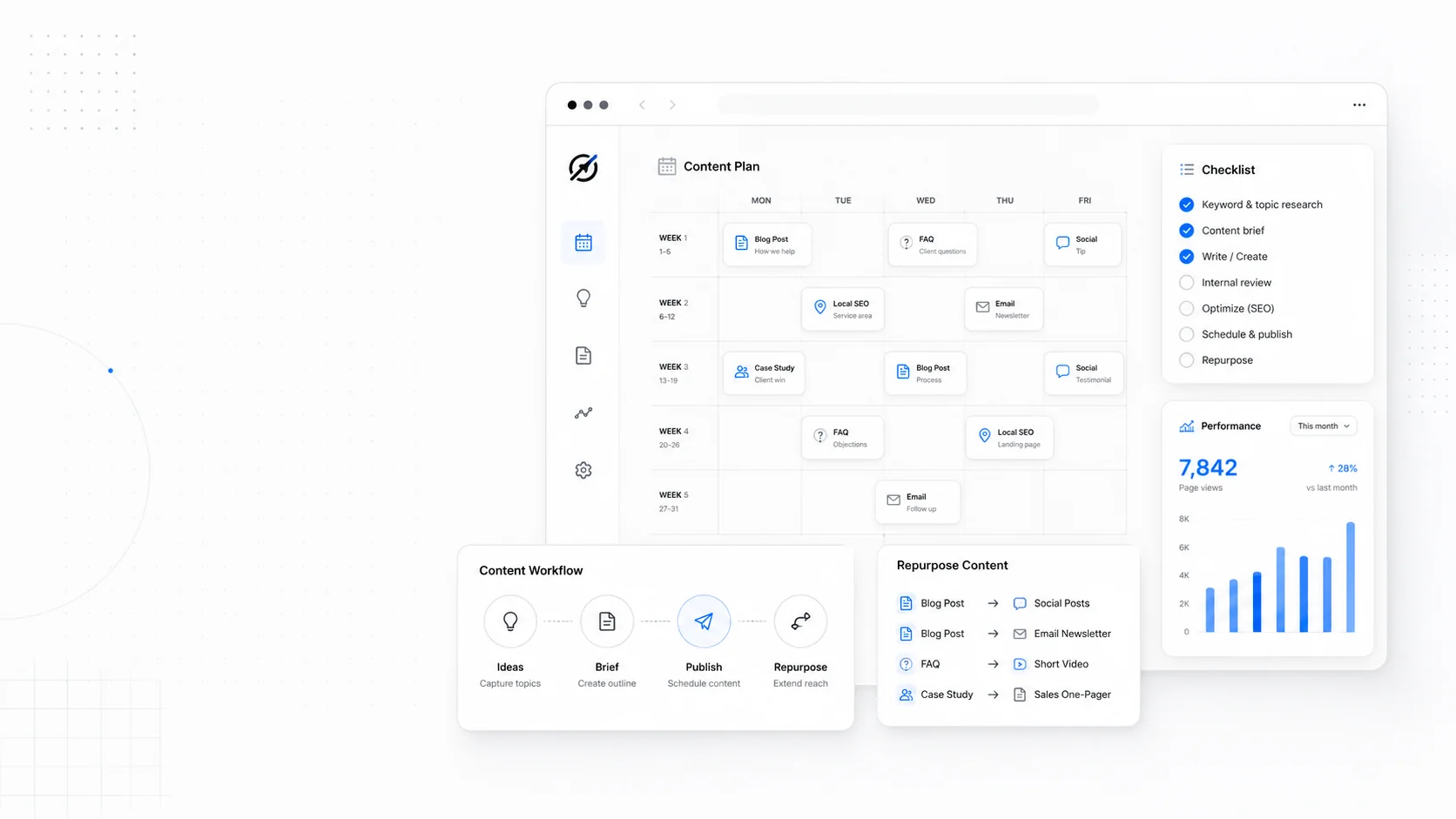
Most small businesses that try content marketing make the same mistake. They start strong — five posts in the first month, big plans, a content calendar shared in a group chat — and then go quiet for nine months. The blog page collects dust. The handful of posts that did go up never got linked to anything, never got updated, and never sent a measurable lead. Eventually someone says "content does not work for us" and the budget moves to ads.
The diagnosis is almost never that content does not work. It is that nobody planned a system that survives a busy quarter. Content strategy for a small business is mostly about designing a workflow that produces useful pages on a cadence the owner can actually sustain — and structuring those pages so each one earns more than its individual traffic.
This guide covers how to do that without a marketing team, without a content agency, and without pretending you have time to publish twice a week.
Decide What You Are Actually Trying to Achieve
Content strategy without an outcome is just typing. Pick one of three goals before you write anything.
The realistic options for a small business:
- Rank for the queries your customers search before buying. This is the most common goal and the one with the clearest ROI. Content exists to capture transactional and commercial-investigation queries.
- Earn trust with people already evaluating you. Content here is read by people who already know your name — case studies, process explanations, FAQs. Lower volume, much higher conversion.
- Build authority in a specific niche. Long-game content for businesses where reputation drives referrals. Slower payoff, but the strongest moat.
Most small businesses should pick the first goal and add elements of the second. The third is usually a distraction unless you have a clear strategic reason. Ahrefs' guide to content marketing for small business is a clean primer if you want to read the longer version, but the discipline is in picking one and refusing to chase the others until the first is working.
Build the Strategy Around Topic Clusters, Not Random Posts
Random blog posts almost never compound. Topic clusters do. The structure, popularised by HubSpot a decade ago and now standard practice, is straightforward:
- A pillar page covers a broad topic comprehensively. It is the canonical resource on the topic for your site.
- Cluster pages cover specific subtopics in depth. Each one links back to the pillar, and the pillar links to each of them.
- The internal links inside the cluster signal to Google that this site has authority on the broader topic.
For a small service business, the pillar should usually be a high-value commercial page (a service page, not a blog post). The cluster posts answer the questions and adjacent topics that people ask before buying that service. The blog feeds the service page; the service page converts the traffic.
Backlinko's guide to topic clusters covers the mechanics. The shortcut: pick your three to five most important services. Build one pillar page for each. Then plan five to ten cluster posts per pillar over the next year. That is your content roadmap.
If your site does not yet have the architecture to support this — strong service pages with deep content, organised navigation, sensible URL structure — that is the work to do first. Our approach to SEO-focused website builds starts with this kind of mapping precisely because content without good architecture leaks most of its value.
Plan a Cadence You Can Survive
The single biggest predictor of whether a small business content program works is consistency. Two posts a month, every month, for two years beats six posts in January and silence after. Pick a cadence that is realistically sustainable in your worst month, not your best one.
For most small businesses with no dedicated marketer:
- One post every two to three weeks is achievable and meaningful. That is 17–26 posts a year.
- One post a month is fine if the posts are substantial (1500+ words, well-researched).
- Anything more frequent than weekly is rarely sustainable without a dedicated person.
Build a backlog of 90 days of topics before publishing the first one. The reason small business content programs die in month four is that the owner runs out of ideas in week three and starts dreading the blank page. A 90-day buffer protects you from that.
The Content Marketing Institute publishes annual research on B2B content benchmarks — the consistent finding is that documented strategies outperform ad-hoc ones, and consistent publishing outperforms larger-but-sporadic publishing. The math is in your favour if you keep showing up.
Choose Topics by Intent and Difficulty, Not Volume Alone
Most small business content programs chase the wrong topics. They target the highest-volume keywords (which are too competitive to win), or they write whatever the owner felt like writing that month (which has no SEO value at all).
The realistic prioritisation:
- Bottom-of-funnel topics first. Comparison posts, pricing posts, "best X for Y" posts. These have lower volume but the people searching are close to buying.
- Question-based content that supports the bottom-of-funnel pages. Pulled from Search Console, AnswerThePublic, and Google's People Also Ask.
- Local content if you serve a defined area. "Best [service] in [neighborhood]" posts often have very little competition and convert remarkably well.
- Industry-specific content that genuinely demonstrates expertise. Slower to rank, but the kind of content that earns links and citations.
Skip the generic "10 tips for X" content unless you genuinely have a unique take. Google has been suppressing thin tips-style content for years, and there is far too much of it on every topic for a small business to compete.
For more on the keyword side of this, our guide on keyword research for service businesses walks through the tools and process to find topics worth writing about.
Make Every Post Actually Useful
The posts that compound for small businesses are the ones a real person would bookmark or share. The ones that do not, do not. The bar in 2026, with AI generating roughly half the noise on the open web, is higher than it has ever been.
The non-negotiables for every post:
- First-hand experience. Mention specific projects, prices, jobs, edge cases. Generic content from a small business is invisible.
- Specifics over abstractions. "We replaced a 40-year-old cast iron stack last March in a duplex in Tremont" beats "we have experience with older homes."
- Real images. Photos of your team, your equipment, your finished work. Not stock images, not AI-generated illustrations.
- Clear structure. H2/H3, bullet points, scannable for the 80% who skim.
- A clear takeaway. A reader should finish knowing more than when they started, ideally with something they can act on.
Google's helpful content guidance is the formal version of this. The shorter version: write the post you would actually want to read if you were the customer searching for the answer.
Repurpose Aggressively to Make One Effort Pay Twice
A single substantial post is the raw material for several pieces of distribution. The repurposing playbook for a small business with no marketing team:
- Pull three to five quotes from each post and schedule them as social posts over the next month.
- Convert the H2s into an email newsletter section or a short video script.
- Rewrite the FAQ at the bottom of the post into individual social or LinkedIn posts.
- Reshoot key parts as a 60-second vertical video for Instagram, YouTube Shorts, or TikTok if your audience is there.
- Use the post as the script for a customer-facing video on the relevant service page. Same words, different format.
- Submit the best posts to relevant industry newsletters or roundups. Many small trade publications accept guest contributions.
Content Marketing Institute's repurposing guidance covers more patterns. The principle: if a post took eight hours to write, it deserves at least eight hours of distribution work. Most small businesses spend the eight hours and then publish the post into the void.
Update Old Content Before Writing New
This is the single highest-ROI activity in content marketing and almost nobody does it.
A post you wrote two years ago that ranks in position 8 for a query worth chasing can usually be moved to position 3 with a half-day of updates. A new post on the same topic might take three days and start at position 30. The math is obvious; the discipline is harder.
The quarterly refresh routine:
- Pull the Performance report in Google Search Console, filtered to position 5–20.
- For each underperforming page, identify what is missing — is the content out of date, are key entities not covered, are the headings weak, is the title tag generic?
- Rewrite, add, or restructure. Update the publish date if the change is substantial. Otherwise, leave it.
- Add new internal links from posts you have published since.
- Resubmit the URL in Search Console.
Search Engine Journal's content refresh guide covers the methodology in more detail. For a small business, refreshing four to six old posts per quarter usually outperforms publishing four to six new ones.
Write the Author's Page (Yours)
E-E-A-T (Experience, Expertise, Authoritativeness, Trust) is not a ranking signal you can directly tweak, but it is a frame Google uses to evaluate content quality. The simplest, cheapest move toward better E-E-A-T signals on a small business site is making the human behind the content visible.
Build a real author page for each contributor:
- A real name and a real photo.
- A short bio that establishes credentials, years of experience, and area of expertise.
- Links to a LinkedIn profile or other public credentials.
- A link from every post they wrote.
For owner-led businesses, this is usually one page — yours. For a small team, three or four. The work is small but the trust signal is meaningful, especially for the kinds of topics where Google looks closely at who is publishing.
Our about page is part of how we build the same signal on our own site, and it is one of the first things we look at on a client's site when evaluating why their content is not converting.
When to Outsource (and How Not to Get Burned)
The honest answer for most small businesses: outsource the production, keep the expertise.
What you should keep in-house:
- The strategy and topic selection. You know your customers; an agency does not.
- The first-hand examples, photos, and specifics that make the content actually useful.
- The final review and edit. The expertise has to come from you.
What you can outsource:
- The structural research, keyword work, and outline.
- The drafting, if the writer has access to your specifics and you edit aggressively.
- The image production, formatting, and CMS upload.
- The repurposing and distribution.
The failure mode is hiring a generalist content agency that produces 20 generic posts at $100 each. None of them rank, none of them convert, and they fill your blog with noise that signals to Google that the site is not high quality. If you are going to outsource, hire a writer with experience in your industry, give them deep access to your work, and review every draft.
If you would rather not run this entirely yourself, our website care plans include a content production option for clients who want a sustainable cadence without building it from scratch. The cadence is realistic, the topics come from research, and the drafts go through your review before they ship.
A Working First-90-Days Plan
If you are starting from scratch and want a sequence that produces results without burning out, the first 90 days look like this:
- Week 1: Pick the three pillar topics. Map out 15 cluster post ideas (five per pillar).
- Weeks 2–4: Build or refine the pillar pages. These are usually service pages, not blog posts.
- Weeks 5–6: Write and publish the first two cluster posts.
- Weeks 7–8: Audit existing content. Update one underperforming post.
- Weeks 9–10: Publish two more cluster posts. Add internal links from new posts to pillars and vice versa.
- Weeks 11–12: Repurpose the published posts for social and email. Set up the next quarter's calendar.
By day 90 you will have three solid pillar pages, six new cluster posts, one refreshed post, and a workflow you can repeat. That is enough to compound for years if you keep at it.
What Success Looks Like
Realistic expectations matter. A small business content program should expect:
- Months 1–3: very little. Search Console may not even show meaningful impressions yet.
- Months 4–6: gradually rising impressions, the first clicks from long-tail queries, the first inbound leads who mention reading something.
- Months 7–12: real traction. Cluster posts ranking in the top 10 for niche queries, pillar pages picking up positions on competitive ones, content-driven leads becoming a measurable channel.
- Year 2 and beyond: compounding. The work you did in month four is still earning traffic in month thirty.
If you are 18 months in and seeing nothing, the issue is almost always topic selection or content quality, not patience. Audit the work honestly and adjust.
The businesses that win at content are the boring, consistent ones. They publish useful work on a cadence, they update what they have already written, they keep the architecture clean, and they outlast competitors who tried to win in three months and quit. Pick the cadence you can sustain, plan around topics that match real intent, and start. The compounding takes care of itself.
If you want help getting the architecture right before you commit to a year of writing, our SEO-focused website builds include the content roadmap as part of the project. Otherwise, the framework above is enough to start. Pick your pillars, plan your clusters, and ship the first post.
More posts from the blog.
From Contact Form to CRM: The Minimum Lead Pipeline Every Service Business Should Automate
A practical lead pipeline for service businesses: connect forms, calls, email, CRM records, reminders, follow-ups, and reporting so good leads stop disappearing.
The 2026 Website Content Refresh Playbook: Updating Old Pages Without Breaking SEO
A practical content refresh process for small business websites: how to update stale pages, preserve rankings, improve AI search visibility, and avoid SEO mistakes.
The AI Chat Widget Decision: When It Helps Leads and When It Hurts Trust
AI chat widgets can qualify leads and answer common questions, but they can also slow the site, invent answers, mishandle privacy, and damage trust. Here is how to decide.
Keep reading?
More field notes from building modern websites and software for real businesses.