
On-Page SEO Checklist 2026: What Still Actually Matters
An on-page SEO checklist for 2026. Title tags, meta descriptions, headings, internal links, entity coverage, and helpful content updates — what still moves rankings.
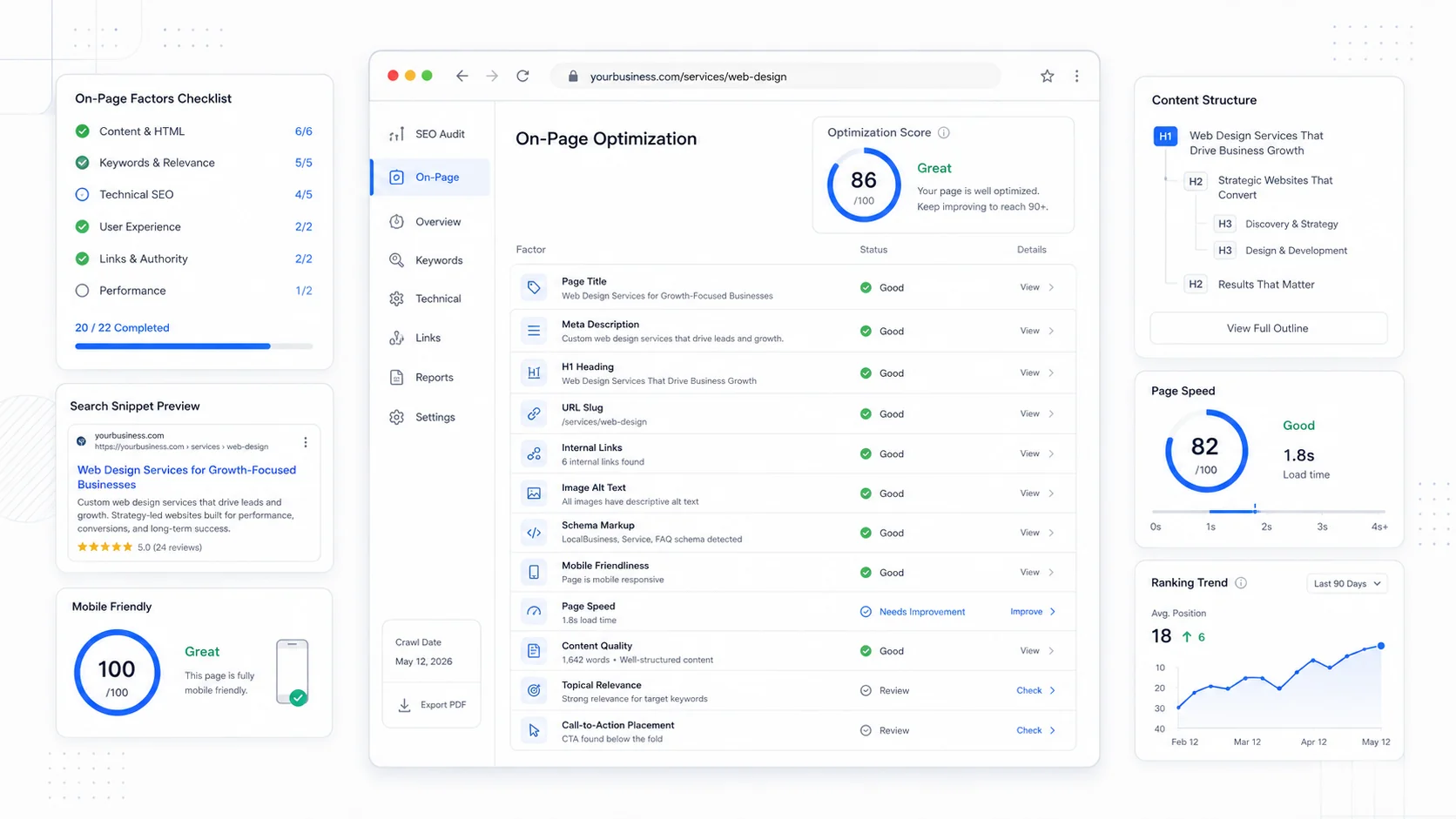
On-page SEO has been declared dead so many times that it is genuinely funny. AI Overviews were going to kill it, then Helpful Content was going to kill it, then SGE was going to kill it. Every cycle, the same prediction; every cycle, the practitioners who actually run sites notice the same thing — pages with clear title tags, sensible headings, and useful content keep ranking, and pages without them keep struggling.
What has changed is the weighting. The old playbook of stuffing exact-match keywords into every heading is genuinely obsolete. The newer game is about being unmistakably about something — covering the topic completely, linking it sensibly to the rest of the site, and giving Google enough signals to confidently classify the page. This guide covers the on-page work that still moves the needle in 2026 and the work that has quietly stopped mattering.
Title Tags: The One Element That Still Punches Above Its Weight
The <title> tag remains the single highest-leverage on-page element. It influences ranking, click-through rate, and how Google understands the page. Get it wrong and even good content underperforms.
The current good practice:
- Lead with the primary keyword when it reads naturally. Google still pays attention to the leftmost terms, and so do searchers scanning a results page.
- Stay under roughly 60 characters to avoid truncation in most desktop layouts. Mobile cuts off sooner. Google does not enforce a hard limit, but truncated titles convert worse.
- Differentiate every page. Duplicate title tags across a site signal weak structure and let Google rewrite them for you, usually badly.
- Include the brand at the end for service pages and the homepage; consider dropping it on blog posts where the topic is the entire point.
- Match the intent of the query. A title that promises a "guide" should rank for guide queries; a title that promises "near me" service should rank for transactional queries.
Google has been more aggressive about rewriting title tags it considers unhelpful. The fix is not to fight the rewrite — it is to write a title clear enough that Google has no reason to override it. Pages with weak, vague, or stuffed titles get rewritten constantly. Pages with sharp, specific titles almost never do.
Run a crawl of your site and sort by title tag. Anything duplicate, missing, longer than 65 characters, or generic ("Home — Acme Plumbing") is on the fix list.
Meta Descriptions: Not a Ranking Factor, Still Worth Writing
Meta descriptions have not been a direct ranking factor for over a decade, and Google rewrites them on roughly two-thirds of search results. So why bother? Because the third Google leaves alone is usually the third where someone actually clicks.
The good-enough practice:
- 150–160 characters, written for the searcher, not the crawler.
- Lead with the value or outcome, not the company name.
- Include the primary keyword once if it fits naturally — Google bolds matching terms in the snippet, which lifts CTR.
- Add a soft action ("get a quote in 24 hours," "book a free site visit") on commercial pages.
- Write unique descriptions for every commercial page; let blog posts use a generated fallback if you must.
Moz's meta description guide is still one of the cleaner explanations of why this small piece of HTML earns disproportionate clicks when it is written well. The realistic standard: write meta descriptions for the 20 pages that drive most of your traffic, and stop worrying about the long tail.
Headings: One H1, Then Real Structure
Headings give Google and screen readers the outline of the page. The rules are simpler than the SEO industry sometimes makes them sound.
The current practice:
- One H1 per page, matching the page's topic. The H1 should usually echo the title tag intent, not duplicate it word for word.
- H2s for the main sections, written as clear, scannable phrases that someone could read aloud as a table of contents.
- H3s for sub-points within an H2. Skip them if the section does not need subdivision.
- Do not skip levels for visual reasons. If you want smaller text, use CSS — not an H4 where an H2 belongs.
- Headings answer questions or describe sections. Stop writing headings like "Our Approach" when "How we ship a project in three weeks" tells the actual story.
MDN's heading structure documentation is worth a read if your team writes inconsistent markup. Headings still matter because they help Google parse the page and they help users navigate. Both audiences reward clarity.
Internal Linking: Probably the Most Underused Lever
Internal links move ranking signal around the site, help Google discover new content, and tell Google what each page is about based on the anchor text pointing at it. Most small business sites do almost no intentional internal linking.
The patterns that work:
- Link from high-authority pages to the pages you want to rank. Your homepage, about page, and most-linked blog posts have the most equity to share.
- Use descriptive anchor text, not "click here" or "learn more." The anchor text is a signal Google reads.
- Build topic clusters. Pillar pages cover broad topics; cluster pages cover specific subtopics; both link to each other. Search Engine Journal's internal linking guide covers this pattern thoroughly.
- Cap outgoing internal links at a sensible number per page. Twenty meaningful internal links beat 200 footer-stuffed ones.
- Link contextually within content. A link inside a paragraph that explains why someone would click it is worth more than the same link in a sidebar nobody reads.
For service businesses, the highest-leverage internal linking work is usually connecting service pages to the related blog content that supports them — and connecting blog posts back to the service pages they implicitly recommend. The blog feeds the services; the services convert the traffic.
If you have a blog and a list of services but they barely link to each other, that is the first place to spend an afternoon.
Entity Coverage: Be Unmistakably About Something
Modern Google does not just match keywords; it matches entities. If a page about "drain cleaning" never mentions hydro-jetting, augers, p-traps, sewer lines, or any related terms, Google has weaker confidence that the page is genuinely about drain cleaning. It might be a thin overview, an affiliate page, or a redirect. Pages that cover the topic completely earn the relevance.
The practical version, often called "entity SEO" or "topical authority":
- Identify the related concepts, products, and questions that any expert page on the topic would naturally cover.
- Use the related entities in the body where they fit naturally. Do not force them; if a real expert would mention them, they belong.
- Cover the obvious adjacent questions on the same page where they make sense (FAQ sections, often).
- Link out to authoritative sources for definitions or deep dives. External links to credible sources are a quality signal, not a ranking leak.
Search Engine Land's coverage of entity-based SEO is the cleanest ongoing reference if you want to go deeper. The shortcut: read the top three ranking pages for your target query, list every concept they all cover, and make sure your page covers them too — better.
This is also the foundation of how AI-driven search systems decide what to cite. Pages that demonstrate complete topical coverage are dramatically more likely to be pulled into AI Overviews and other generative results.
Helpful Content: Write Like a Human Who Knows the Topic
Google's Helpful Content system is no longer a separate update — it is woven into core ranking. The questions Google effectively asks of every page:
- Does this content provide original information, reporting, research, or analysis?
- Does it demonstrate first-hand expertise?
- Does it leave the reader feeling they have learned enough to act?
- Does it avoid the obvious pattern of "here are 10 things about X" with no real insight?
The signals it tries to suppress:
- Content written primarily to rank rather than to help.
- Content that summarises what other pages say without adding anything.
- Content that promises an answer in the title and pads for 1500 words before delivering.
- Pages stuffed with synonyms and variations to capture every possible phrasing.
- Content produced at scale with little editorial judgement.
The practical implication for a small service business: every page on your site should be obviously written by someone who knows the work. Mention specifics. Describe edge cases. Quote real prices when you can. Link to your own past projects on your projects page. Show photos of your team. The opposite of "AI-generated content nobody touched" is the page that ranks.
Images: Compressed, Sized, Alted, and Lazy-Loaded
Images are simple but they are also where most small business sites quietly break their own performance and accessibility scores.
The non-negotiables:
- Compress every image before upload. AVIF or WebP for photos, SVG for icons and logos.
- Resize to actual display dimensions. A 1200-pixel hero displayed at 600 pixels is a wasted half a megabyte.
- Set explicit
widthandheightattributes to prevent layout shift. - Use real
alttext that describes the image content for screen readers and image search. Skip alt text only on purely decorative images, where you should usealt="". - Lazy-load offscreen images with
loading="lazy". Do not lazy-load the LCP image. - Name files descriptively.
kitchen-remodel-cleveland-2025.jpgis better thanIMG_4827.jpg.
web.dev's image optimisation guide covers the modern best practices. Image work is also Core Web Vitals work, since the LCP element is usually an image.
Schema Markup Where It Earns Its Place
Schema does not directly improve rankings, but it can earn richer search results, increase CTR, and make your content more eligible for AI-driven features. For a small business, the types that consistently pay off:
- Organization or LocalBusiness on the homepage.
- Service schema on service pages.
- Article or BlogPosting on blog posts.
- BreadcrumbList for hierarchical navigation.
- FAQPage for genuine FAQs (Google has tightened display eligibility, but the markup is still useful for understanding).
- Review and AggregateRating where you have real, on-site reviews.
Schema.org is the source of truth for vocabulary, and Google's structured data documentation covers what is currently eligible for rich results. Validate every implementation with the Rich Results Test before shipping.
For a deeper walk-through tailored to small business sites, our practical guide to schema markup covers the types that actually matter and how to implement them without breaking your current site.
URL Structure: Boring and Stable
URLs do not move rankings the way they did fifteen years ago, but bad URL structure still creates problems — duplicate content, redirect chains, weak internal linking. The current rules:
- Lowercase, hyphenated, no trailing slash inconsistencies.
- Short and descriptive.
/services/drain-cleaningbeats/services/drain-cleaning-and-sewer-services-in-the-greater-cleveland-area-2025. - Stable. Do not restructure URLs unless you genuinely have to. Every change costs link equity through the redirect.
- No session IDs, tracking parameters, or unnecessary query strings in canonical URLs.
If you are planning a redesign and considering a URL change, read Google's URL structure best practices first and pair every redirect with a 301 plan. We cover the migration playbook in our SEO-focused website builds, because the URL strategy is one of the most-disturbed and least-considered parts of a typical rebuild.
What Has Stopped Mattering
A few things deserve to die. In 2026, you can stop spending time on:
- Keyword density. Stop counting. Write naturally; cover the topic.
- Exact-match keywords in every heading. Google handles synonyms and variations.
- Meta keywords. Have not been used by Google since the early 2000s.
- Stuffing the footer with city names. Every search engine sees through it.
- Hidden text or CSS-shrunk content. A penalty waiting to happen.
- Long, padded intros that delay the answer. Both readers and Google reward pages that get to the point.
- AI-generated content with no editing or expertise layered in. The algorithmic detection has improved; the helpful-content evaluation does not care whether AI helped, only whether the result is genuinely useful.
A Working Order of Operations
If you are looking at a real site and wondering where to spend the next four hours of on-page work, the order that produces the most movement:
- Audit and rewrite title tags for every commercial page.
- Write unique meta descriptions for the top 20 traffic-driving pages.
- Fix heading structures — one H1, sensible H2s, no skipped levels.
- Add intentional internal links between blog posts and service pages.
- Identify the top three pages stuck in positions 5–15 and rewrite them for entity coverage.
- Compress, resize, and alt-tag every image on key pages.
- Add or repair schema on service pages and the homepage.
- Audit URLs only if you find duplicates or genuinely broken patterns.
On-page SEO is not glamorous in 2026, but the work compounds. Sites that get this right give themselves a structural advantage that survives algorithm updates, AI Overviews, and whatever comes next. Most of it is the same craft it always was — write clearly, structure cleanly, link intentionally, mean what you say.
If you would like a second set of eyes on your current pages, that audit is part of every SEO-focused website build we ship and a regular task on our website care plans. Either way, run the checklist once on your most important page. The findings tend to be cheaper to fix than the missed traffic costs.
More posts from the blog.
From Contact Form to CRM: The Minimum Lead Pipeline Every Service Business Should Automate
A practical lead pipeline for service businesses: connect forms, calls, email, CRM records, reminders, follow-ups, and reporting so good leads stop disappearing.
The 2026 Website Content Refresh Playbook: Updating Old Pages Without Breaking SEO
A practical content refresh process for small business websites: how to update stale pages, preserve rankings, improve AI search visibility, and avoid SEO mistakes.
The AI Chat Widget Decision: When It Helps Leads and When It Hurts Trust
AI chat widgets can qualify leads and answer common questions, but they can also slow the site, invent answers, mishandle privacy, and damage trust. Here is how to decide.
Keep reading?
More field notes from building modern websites and software for real businesses.