
Landing Page vs Homepage: When to Use Each (and Why It Matters)
When to send paid traffic to a landing page vs a homepage: message match, single CTA, audience temperature, and the conversion cost of getting it wrong.
A common mistake among small businesses running paid ads: they spend two thousand dollars a month on Google or Meta, point all of it at the homepage, and then wonder why the cost per lead is climbing. The ads are fine. The homepage is fine. The problem is that they are the wrong tool for the job that the other one is doing.
A homepage and a landing page are different products. They serve different audiences, use different copy, and are measured against different goals. Treating them as interchangeable is the kind of small architectural mistake that costs money quietly for years. This is the practical guide to which one to use, when, and why.
What Each One Is Actually For
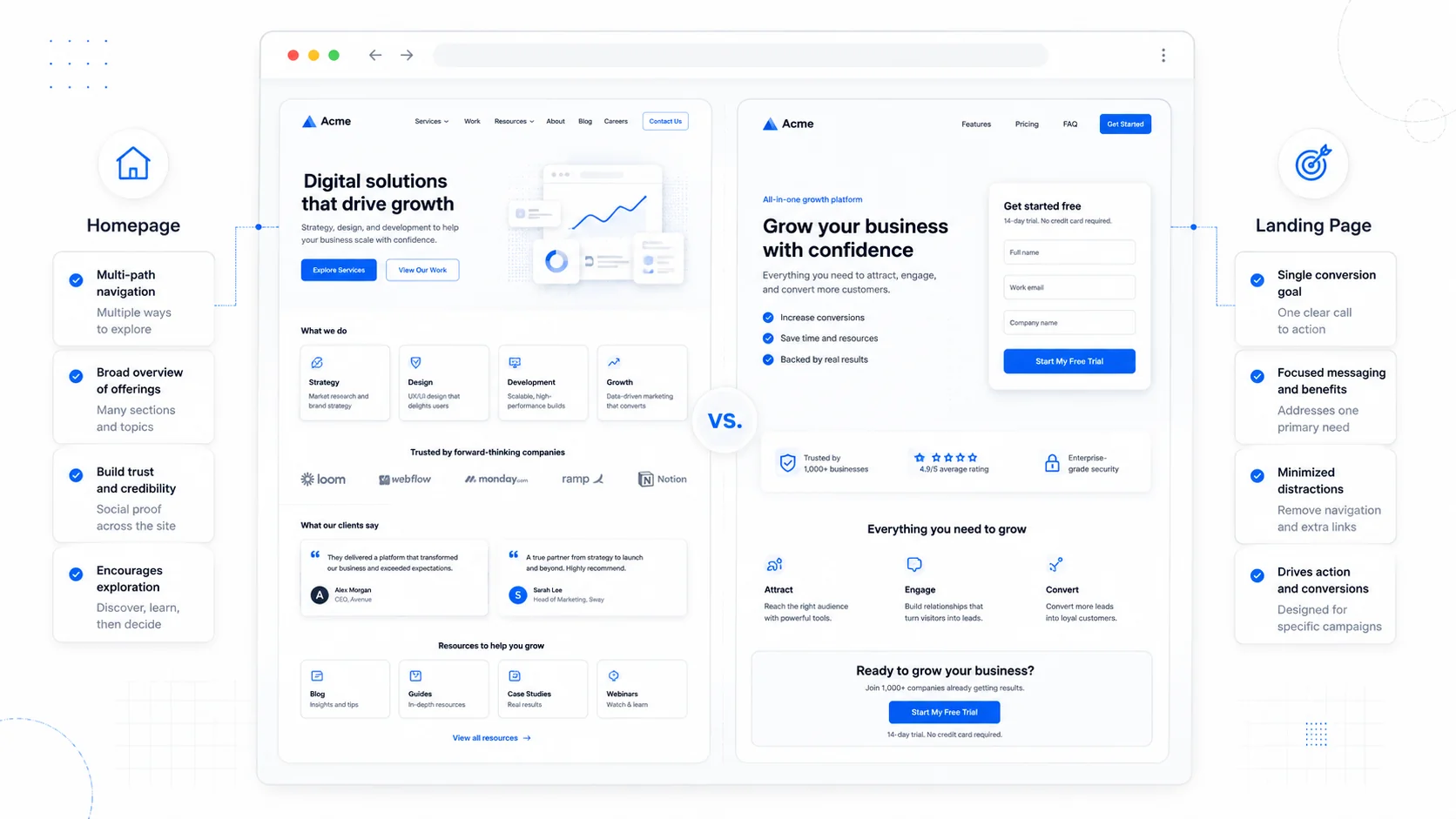
A homepage is the front door of your business. It serves a mixed audience: people who Googled your company name, people who clicked your link in an email signature, people who are comparing you against competitors, people who came from a referral, journalists, suppliers, prospective hires. The homepage has to answer "who are you and what do you do?" for all of them, and then route each to the right next page.
A landing page is the destination for a specific campaign. It serves one audience that arrived for one reason — usually because they clicked an ad or a link with a specific promise. The landing page has to extend that promise, remove every distraction, and lead to one specific action. It is a single decision point, not a hub.
Unbounce's annual conversion benchmark report consistently shows landing pages outperforming homepages on conversion rate from paid traffic, often by a factor of two or three. The reason is structural, not stylistic. The landing page is built around one job. The homepage is not.
Why Sending Ads to Your Homepage Costs You
When a visitor clicks an ad for "Same-day plumbing in Calgary" and lands on a homepage that lists nine services, has three different CTAs, and buries the same-day promise three scrolls down, three things happen at once.
Message match breaks. The visitor clicked a specific promise. The page they landed on is generic. Their brain does the work of deciding whether they are still in the right place, and a meaningful percentage of them decide they are not. CXL's research on message match is direct: when the headline of the destination page does not echo the language of the ad, conversion rate drops measurably.
Decision load goes up. The homepage has multiple offers. The visitor came for one. Now they have to scan, ignore, and decide what to click. The Hick-Hyman law, explained well by the Interaction Design Foundation, is the formal version of "more choices, slower decisions, fewer decisions made." A homepage is structurally a long list of choices.
Tracking gets fuzzier. The homepage is a hub for many traffic sources. Attributing a conversion to a specific ad campaign is harder when the page sees organic, direct, referral, email, and paid traffic all at once. A campaign-specific landing page lets you measure clean.
The cost is rarely catastrophic — homepages do convert. But on paid traffic, they convert at maybe a third of the rate of a properly built landing page. If you are spending real money on ads, that gap is the entire margin.
The Three Questions That Decide
Before building a landing page, three questions decide whether one is even the right answer.
Where is the traffic coming from? Paid search and paid social almost always benefit from landing pages because the audience is cold or warm but specific. Organic search, branded search, email lists, and referral traffic are usually better served by deeper pages on the main site (a service page, a project page, a blog post) because the visitor is exploring, not converting on a single click.
Is there one offer? A landing page works when there is one specific offer to make: book a quote, download a guide, register for a webinar, claim a discount, schedule a consultation. If your campaign is genuinely about three things, you probably need three landing pages, not one with three CTAs.
Will the page get enough traffic to learn from? Building a one-off landing page for a campaign that will see two hundred visitors total is rarely worth the engineering. The break-even point varies, but a useful rough rule: if a campaign will drive at least a thousand visits to one offer, the lift from a dedicated landing page usually pays for the build several times over.
If the answer to all three is yes, build the landing page. If the answer to any of them is no, the ad money is probably better spent improving the relevant deep page on the main site.
What Makes a Landing Page Different
The structural differences between a landing page and a homepage are not stylistic. They are functional.
One CTA, repeated. A landing page has one primary action, repeated at the natural decision points down the page (hero, after social proof, end of page, sticky on mobile). A homepage has multiple paths because it serves multiple audiences. We covered the patterns in our conversion-focused landing page post.
No site navigation. The classic landing page has a stripped-down header — usually just the logo — and no full nav menu. This is deliberate. The header on a homepage exists to route visitors to the right deeper page. The header on a landing page exists to keep them on the page they arrived at. Removing the nav consistently lifts landing page conversion rate by a small but real amount, and the trade-off (slightly worse experience for the small fraction of visitors who want to wander) is usually worth it.
Message match in the headline. The landing page headline should echo the language of the ad that drove the click. If the ad said "Same-day plumbing in Calgary," the headline should say "Same-day plumbing in Calgary," not "Welcome to Acme Plumbing." This is the single highest-leverage change a landing page can make over a homepage for paid traffic, and it is also the easiest to neglect.
One audience, not many. The copy is written for the specific person the ad targeted. If the ad is to "small business owners in Edmonton looking for a new accountant," the page talks to small business owners in Edmonton looking for a new accountant. Not to "businesses of all sizes." The specificity is what makes the page feel like a fit instead of a brochure.
Proof tuned to the offer. Testimonials, case studies, and ratings on a landing page should support the specific offer. A page about "kitchen renovations in Inglewood" should have testimonials from kitchen renovation clients in Inglewood, not the general portfolio. The Baymard Institute's checkout research has been making this point for years: trust elements work hardest when they are tied to the specific decision the visitor is about to make.
When a Homepage Is Actually the Right Destination
Landing pages are not always the answer. There are real cases where the homepage is a better destination, even for paid traffic.
Branded search. When someone Googles your company name, they are looking for you specifically. The homepage is the right answer because it is the canonical place to be introduced to the business. Sending branded search clicks to a single-offer landing page is a missed opportunity to be properly browsed.
Retargeting visitors who already know you. If someone has already been to your site, clicked around, read a blog post, and is now seeing a remarketing ad, sending them to the homepage or a deeper page they have not seen is often more useful than a single-offer landing page. They are warm. They have done their homework. They want to keep exploring.
Awareness campaigns. If the campaign is about introducing the business to a new audience, with no specific offer attached, the homepage is the natural destination. Branding ads for "Acme is hiring," general awareness ads, sponsorships of community events — these usually want to introduce the business holistically, not push one offer.
Multi-service businesses with broad messaging. A few service businesses are genuinely a "see what fits" proposition where the right move is to land the visitor on a homepage that exposes the range. This is rare, and it should be a deliberate choice, not the default because no one built a landing page.
Single Page or a Page Per Offer?
If you have multiple offers running in paid traffic, the question is not "should I build a landing page?" but "how many?" The answer is almost always one per offer.
The reason is message match. If your ad says "Free 15-minute SEO audit," the page needs to be about a free 15-minute SEO audit. If another ad says "$200 off your first month of bookkeeping," that needs its own page about $200 off a first month of bookkeeping. Trying to combine them into one page with two CTAs gets you the worst of both: weaker message match, weaker focus, weaker conversion.
For small businesses with limited dev resources, the SEO-focused website builds we deliver usually include a small library of templated landing pages so adding a new offer is a content task, not an engineering one. The structural decisions (one CTA, no nav, fixed sections) are baked in. The variable is the copy, the photo, and the proof.
Single-Step or Multi-Step Form?
The form on a landing page is usually where the conversion lives or dies. The choice between a single-step form and a multi-step form matters more than people think, and it depends on the offer.
Short offers (newsletter signup, callback request, quick quote) usually convert better with a single-step form of three to four fields. The page is short, the form is short, the visitor commits in one motion.
Longer offers (full quote requests, intake forms, project briefs) almost always convert better when split into two or three steps with a visible progress bar. The first step is the easiest one (name, email). The second and third steps collect the qualifying detail. CXL's research on multi-step forms shows the gain comes from perceived shortness, not actual data reduction. The visitor commits to step one before they realise step three exists.
We covered the form-design specifics in our form best practices post.
Performance Matters More on a Landing Page
Every second of load time on a landing page costs you money in two places: the ad spend that brought the visitor in, and the conversion you lose because they bounced.
Google's research on mobile page speed put the bounce probability at 32 percent higher when mobile load time goes from one to three seconds. The web.dev guide on Core Web Vitals is the canonical reference for the metrics that matter.
For landing pages specifically:
- The hero image is usually the Largest Contentful Paint. Compress it aggressively. Use modern formats like AVIF or WebP. Size it for the actual rendered dimensions, not the original.
- Avoid third-party scripts that block rendering. Heatmap tools, A/B test scripts, chat widgets, and pixel-heavy analytics suites add up quickly.
- Defer or async-load anything that is not needed for the first paint.
- Self-host fonts where possible, or limit web font usage to one family with two weights.
A landing page that takes four seconds to render its hero on a mid-range Android phone is a landing page that has already lost a meaningful chunk of its visitors before they read the headline. Our Core Web Vitals guide covers the technical detail.
What to Track
A landing page is rarely "done" the day it ships. The most useful signals to watch in the first thirty days:
- Conversion rate by traffic source. A landing page that converts at 6 percent on Google Ads and 1 percent on Facebook Ads is telling you something about audience match.
- Form start rate vs. completion rate. If many people start the form but few finish, the form is the problem, not the page.
- Scroll depth. If most visitors do not scroll past the hero, either the hero is doing its whole job or it is failing to invite them to keep going.
- Click-through rate from the ad. A landing page can only convert what the ad sends it. If the ad's CTR is low, the landing page is not the variable to test.
- Cost per lead, not just conversion rate. A page that converts at 8 percent on a $30 click is worse than a page that converts at 4 percent on a $5 click.
Google Analytics 4 and the GA4 documentation on conversion tracking is the baseline. For deeper qualitative insight, session replay tools like Hotjar or Microsoft Clarity show you where visitors actually pause, scroll, and leave. The qualitative signal is often more useful than the quantitative one for figuring out what to change next.
A Practical Action List
If you are running paid traffic to your homepage, the first set of changes is short:
- Audit your current ad campaigns and write down the offer of each one. Anything with one specific offer needs its own landing page.
- For each landing page, copy the exact language of the ad into the headline. Message match is the cheapest lift available.
- Strip the navigation off the landing page. One logo, no menu, one CTA repeated.
- Tune the proof to the offer. A page about kitchen renovations gets kitchen renovation reviews, not the general portfolio.
- Measure cost per lead, not just conversion rate. The ad spend is the denominator.
- For non-paid traffic — branded search, referral, email — keep sending people to the homepage or to deep service pages. The landing page is a paid-traffic tool.
If you want a second pair of eyes on your campaign architecture, get in touch. Most small businesses spending on ads are leaving money on the table not in the ad creative but in the page they send the click to, and the gap between a good landing page and a homepage is almost always wider than the gap between a good ad and a great one.
More posts from the blog.
From Contact Form to CRM: The Minimum Lead Pipeline Every Service Business Should Automate
A practical lead pipeline for service businesses: connect forms, calls, email, CRM records, reminders, follow-ups, and reporting so good leads stop disappearing.
The 2026 Website Content Refresh Playbook: Updating Old Pages Without Breaking SEO
A practical content refresh process for small business websites: how to update stale pages, preserve rankings, improve AI search visibility, and avoid SEO mistakes.
The AI Chat Widget Decision: When It Helps Leads and When It Hurts Trust
AI chat widgets can qualify leads and answer common questions, but they can also slow the site, invent answers, mishandle privacy, and damage trust. Here is how to decide.
Keep reading?
More field notes from building modern websites and software for real businesses.