
The True Cost of Cheap Websites: What $500 Builds Actually Cost You
The hidden math behind cheap websites: lost leads, security risk, vendor lock, rebuild costs, and maintenance debt — with real numbers for service businesses.
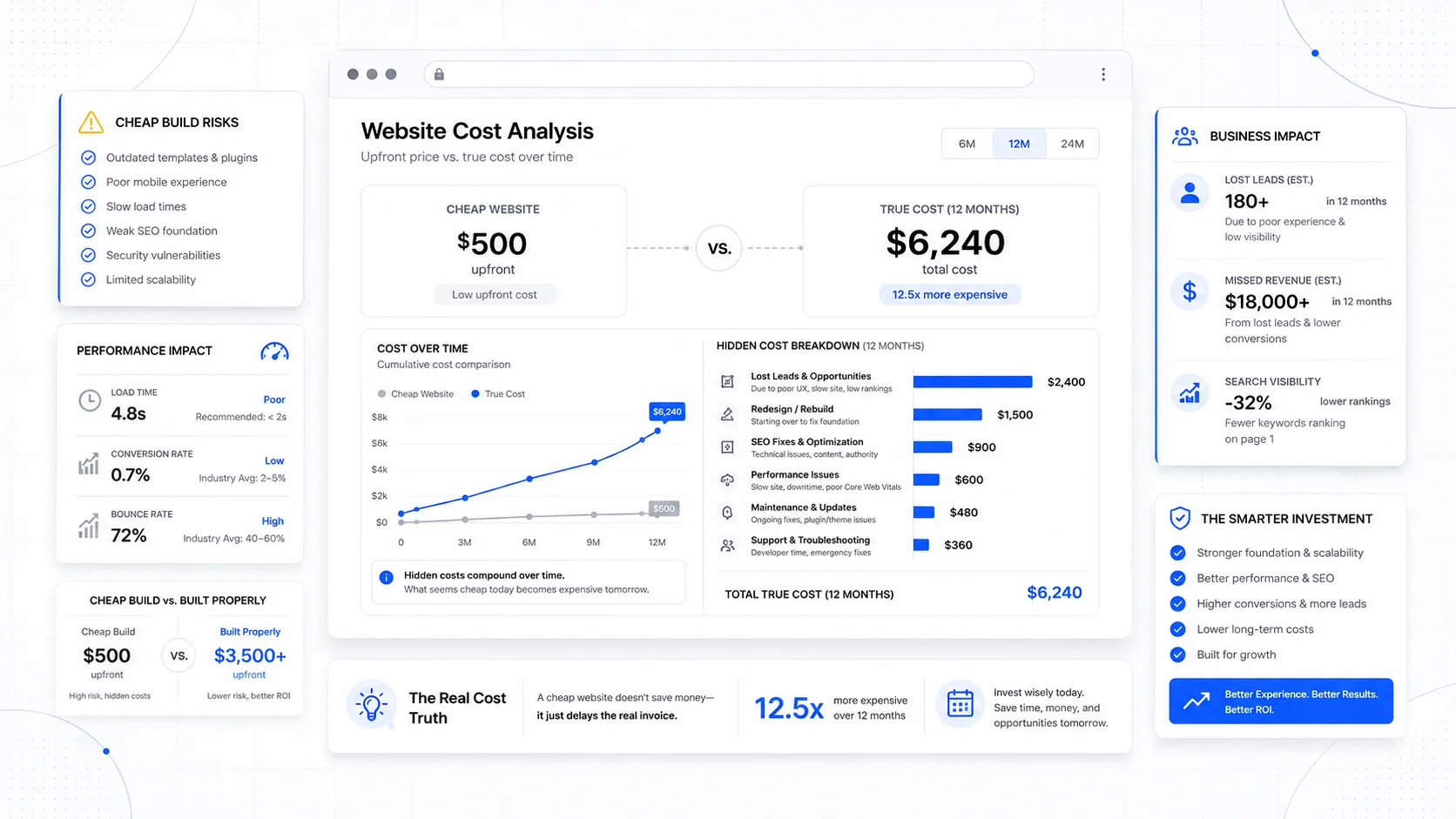
The pitch is familiar. A $500 website, ready in a week, professional design, mobile-friendly, all the bells and whistles. For a small service business with limited capital, the math looks obvious. Why would you pay $8,000 when you can pay $500?
The answer lives in the numbers nobody puts on the invoice. The sticker price of a cheap website is real. So is the second invoice — the one you do not see — that gets paid in lost leads, support time, security incidents, and the eventual rebuild that costs three times what doing it right would have.
This post breaks down what $500 builds actually cost a service business over five years, with rough math you can run on your own situation.
Why "Cheap" Has Two Meanings
Cheap can mean low cost relative to value (a good deal) or low cost relative to function (a bad investment that looks like a good one). The $500 website is almost always the second kind.
A real cost analysis of a website includes the build, hosting, maintenance, lost opportunity from underperformance, security exposure, vendor lock-in, and the cost of the rebuild that becomes inevitable when the cheap version reaches end of life. When you add those up, the $500 build is often the most expensive option on the table.
The Small Business Administration's marketing guidance makes the same point in plain language: under-investing in core marketing infrastructure is one of the most common reasons small businesses fail to grow. A website is core marketing infrastructure for almost every service business.
What You Actually Get for $500
Strip away the marketing language and the $500 website is a known quantity:
- A theme or template used by thousands of other businesses.
- 5 to 10 hours of someone's time, often offshored, often junior.
- Stock photos, generic copy, no real strategy.
- Hosting on a shared platform you do not control.
- Forms that send to a personal email account, with no CRM or automation.
- No analytics setup beyond the default page-view counter.
- No SEO architecture, no schema, no real performance work.
- A page that "looks fine" on desktop and is often slow on mobile.
This is not a strawman. We have seen dozens of these builds over the years. They share a remarkable consistency: identical layout patterns, identical stock photo choices, identical "Welcome to our company" hero sections.
A site that looks like a thousand other sites does not carry the brand weight of a serious business. According to Stanford's web credibility research, visual design accounts for nearly half of the trust judgment a visitor makes in the first three seconds of arriving on a site. A generic template signals "we did not invest in this" before a single word is read.
Cost #1: Lost Leads From Poor Conversion
This is the biggest single hidden cost, and the easiest to underestimate.
A typical service business website converts somewhere between 1 and 5 percent of visitors into leads. The WordStream conversion benchmarks place legal services around 7 percent on the high end and home improvement around 4 percent on average. A well-designed, fast, trust-building site sits at the upper end of the range. A generic $500 build typically sits at the bottom.
The math, for a small service business with 1,000 monthly visitors, an average customer worth $2,500 in gross profit, and a 90 percent close rate from qualified leads:
- Cheap site at 1.5 percent conversion: 15 leads per month, ~14 closed customers, ~$35,000 monthly contribution.
- Better site at 3 percent conversion: 30 leads per month, ~27 closed customers, ~$67,500 monthly contribution.
- Difference: $32,500 per month, or $390,000 per year.
Even if you cut those numbers in half because your traffic, average customer value, or close rate is lower, the gap is still six figures per year. The $7,500 you saved on the build cost the business $200,000 in annual contribution.
This is the largest hidden cost of cheap websites, and it compounds. Every month the underperforming site is live is another month of leads going to competitors. Our piece on conversion patterns that actually convert covers the design choices that drive the difference.
Cost #2: Security Risk and Incident Cleanup
Cheap websites are usually built on platforms that do not get the same security attention as professional builds. Outdated WordPress installations, unpatched plugins, weak admin credentials, no firewall, no backup strategy.
The Sucuri annual website threat report consistently shows that small business websites are the most common target for opportunistic attacks, mostly because they are easy. WordPress sites with unpatched plugins account for the majority of compromised sites year after year.
The cost of a single incident:
- Cleanup: $300 to $3,000 in emergency developer time, depending on the damage.
- Downtime: Lost leads while the site is offline or showing a malware warning, often $1,000 to $10,000 in opportunity cost over a few days.
- Reputation: Some visitors who hit a "this site may be hacked" Google warning never come back.
- SEO recovery: If Google flagged the site, full recovery often takes 30 to 90 days.
A single incident can cost more than a properly built site. Most cheap-build owners will experience at least one incident in the first three years. Many experience multiple.
A professional build on a maintained platform with active patching, monitoring, and a real backup strategy avoids almost all of this.
Cost #3: Maintenance Debt That Compounds
A cheap website is not maintained. It cannot be — there is no budget for it. Plugins go unpatched. Software versions fall behind. Third-party scripts break. Performance degrades.
The web.dev research on long-term performance shows that sites without active maintenance lose Core Web Vitals scores within 12 to 18 months as third-party scripts, image weight, and CMS bloat accumulate. Performance loss directly correlates with conversion loss. Google's page experience research shows that even a 1-second slowdown in load time correlates with a 7 to 20 percent drop in conversion, depending on the industry.
The maintenance debt compounds. Year one, the site is acceptable. Year two, it is slow and slightly broken. Year three, the editor barely works, the contact form has been silently sending submissions to a deleted email for six weeks, and an SSL renewal got missed.
The cost of this is not a single line item. It is a slow erosion of every metric that matters: traffic, conversion, trust, time-to-fix-anything. The HubSpot research on small business marketing consistently finds that maintenance neglect is the largest single reason small business websites underperform their potential.
Cost #4: Vendor Lock and the Eventual Rebuild
Cheap websites are usually locked to the vendor who built them. The hosting account is in the vendor's name. The theme is a custom modification of a template they have licensed. The "CMS" is a hodgepodge of plugins they configured. The login credentials are on someone's laptop.
When you decide to leave (and you will), the cost surfaces. You will pay to:
- Migrate hosting to an account you control. $500 to $2,000.
- Untangle whatever custom modifications they made. $1,000 to $5,000.
- Audit and rebuild the parts that are too fragile to migrate. Potentially the entire site.
- Recover SEO if URLs change during the migration. Months of organic traffic loss is common when this is mishandled. Our WordPress migration plan covers the right way to do this.
Most cheap builds end with a full rebuild within three to five years. The total cost of that arc — original $500 build, plus three to five years of incidents and missed conversions, plus a $10,000 to $20,000 rebuild — is typically two to four times what an honest professional build would have cost upfront.
McKinsey's research on tech debt frames the same dynamic at enterprise scale: the cost of replacing a fragile system is almost always higher than the cost of building it well in the first place.
Cost #5: The Opportunity Cost of Time
This is the cost owners feel most acutely but rarely quantify. Every hour spent fighting with a broken cheap website is an hour not spent on customer work, sales calls, or hiring.
A typical pattern with cheap builds: the owner or office manager spends 2 to 5 hours per month dealing with the site. Pages do not update correctly. The contact form stops working and they did not notice for two weeks. They cannot figure out how to add a new service page. The mobile menu breaks after a plugin update.
At a conservative $75 per hour for owner time, 3 hours per month, that is $2,700 per year, every year, for as long as the site exists. Over five years, that is $13,500 in time alone, on top of every other cost. The Bureau of Labor Statistics data on small business owner hours shows time is consistently the scarcest resource for small business operators, and spending it on website firefighting is a misallocation.
A professional build with a proper maintenance plan takes essentially zero owner time month to month. Updates happen in the background. Issues are caught and fixed before the owner notices. The time saved is not a soft benefit. It is a real reallocation of capacity to revenue work.
Cost #6: Lost SEO Compounding
Search engine rankings are won over years. A cheap site that does not have proper SEO architecture (clean URLs, schema markup, fast load times, mobile-first responsive layout, internal linking) will not rank for anything competitive, and will lose ground to competitors who invested in this.
The Google Search Central documentation is explicit that page experience signals are now part of ranking. A slow, generic, schema-less site is a page Google has reasons to rank below a faster, more trustworthy alternative. Over years, this compounds: every lost ranking position costs traffic, every lost month of traffic costs revenue, and the gap between you and the competitor who invested gets harder to close.
The economic cost of lost organic search position is invisible because it never appears as an invoice. It appears as the customer who chose someone else because they found someone else first. An SEO-focused build is one of the highest-ROI investments a service business can make precisely because the compounding works in both directions.
Running the Real Math On Your Situation
You can calculate the true cost of your current cheap site in about 20 minutes with three numbers.
- Average gross profit per customer (from your accounting).
- Monthly website visitors (from your analytics).
- Current conversion rate from visitor to qualified lead (from your CRM, or estimated at 1 to 2 percent for an unoptimized cheap site).
Calculate current monthly contribution: visitors × conversion × close rate × gross profit. Then calculate what the same site would produce at a 50 percent higher conversion rate, which is realistic with a competently designed and optimized site.
The difference is your monthly opportunity cost. Multiply by 12 for annual. Compare to the cost of a real build. If the gap is larger than the build, the cheap site is the more expensive choice. For most service businesses we run this calculation with, the gap is a multiple of the build cost.
For more on how to do this calculation rigorously, see our pieces on website ROI metrics and website pricing in 2026.
When a Cheap Website Is Actually the Right Call
There are real cases where a $500 site is the right answer. Be honest about whether you are in one.
- A brand-new business with zero customers and no idea whether the business model will work. Spend $500 to test, then invest properly when the model proves out.
- A side project that is genuinely a hobby and not expected to drive revenue.
- A temporary holding page while a real site is being built.
- A small one-person operation with no plans to scale, where the site exists only to confirm the business is real.
Outside of those cases, a $500 website is a $50,000 mistake spread over five years.
Action Items
If you have a cheap website now and you are wondering whether to keep limping along:
- Run the conversion math above. Calculate the real annual cost of underperformance.
- Audit security and uptime: when was the last platform update, when was the last backup, when did you last verify the contact form works.
- Calculate maintenance debt: hours per month you or someone on your team spends on the site times their hourly rate times 12.
- Decide where you are in the rebuild timeline. If the site is over three years old and showing strain, the rebuild is closer than you think.
- Make the investment proportional to the business outcome. A $5,000 site that produces $50,000 of additional pipeline contribution is not an expense. It is a multiple.
Cheap websites are a category of decision that punishes you slowly. By the time the cost is obvious, the cost has already been paid. The honest move is to make the right investment up front, treat the website as the business asset it actually is, and stop paying the hidden invoices that nobody put on a piece of paper. If you would like a candid second opinion on whether your current site is costing you more than a rebuild would, get in touch and we will run the numbers with you.
More posts from the blog.
From Contact Form to CRM: The Minimum Lead Pipeline Every Service Business Should Automate
A practical lead pipeline for service businesses: connect forms, calls, email, CRM records, reminders, follow-ups, and reporting so good leads stop disappearing.
The 2026 Website Content Refresh Playbook: Updating Old Pages Without Breaking SEO
A practical content refresh process for small business websites: how to update stale pages, preserve rankings, improve AI search visibility, and avoid SEO mistakes.

The AI Chat Widget Decision: When It Helps Leads and When It Hurts Trust
AI chat widgets can qualify leads and answer common questions, but they can also slow the site, invent answers, mishandle privacy, and damage trust. Here is how to decide.
Keep reading?
More field notes from building modern websites and software for real businesses.